Essential news and analysis from Kentucky’s state and local governments on housing, planning, and economic development
City County Connector
Lexington’s Urban County Council was remarkably active last month with full agendas in their meetings before their Easter and Spring Break recesses, including taking action on several items of particular interest to real estate and economic development interests.
The Council heard a presentation from the General Government & Planning (GG&P) Committee on March 10, 2026, with recommendations to address the inefficiencies and chokepoints of the residential development processes in Fayette County. One of the key recommendations was establishing a Development Liaison position within the Lexington-Fayette Urban County Government that would operate independent of the departmental silos to provide oversight and guidance for pending development plans. Unfortunately for the development community, discussion of the Development Liaison turned political almost immediately, with several council members wanting the new position within the Department of Planning and Preservation rather than as an independent actor with sherpa and ombudsman-like authorities.
It should come as no shock, then, that at the March 26, 2026 Urban County Council meeting, the Council gave unanimous consent to a first reading of the ordinance that reorganizes the LFUCG Divisions and Departments structure so that the Division of Engineering and the Division of Building Inspection are removed from the Department of Environmental Quality and Public Works and are now under the authority of the Department of Planning and Preservation. This move not only consolidates considerable bureaucratic power and influence under Commissioner Keith Horn’s departmental authority, but, importantly, brings authority over the technical engineering manuals and their application to development plans into the same office (mentioned in the March 13 edition of At the Hall and Hill).
Finally, from Lexington, an interesting postscript to the large-scale solar farm Zoning Ordinance Text Amendment is playing out through the press and in Council Chambers. At that March 10 GG&P Committee meeting, during which the solar farm ordinance passed and was forwarded to the Rural Land Management Board and Environmental Commission for review and committee and public comment, a heated discussion broke out about the process from which the proposed ordinance originated. A “Work Group” composed of council members Liz Sheehan, Dave Sevigny, Hil Boone, and Tyler Morton met with certain constituent and industry groups and prepared the ZOTA draft, which will receive full public scrutiny, as mentioned. However, Fayette Alliance, among other rural preservation interests, vociferously complained and indignantly resented not having their voice heard during the Work Group.
Queue the local paper of record to the rescue. On March 19, 2006, the Lexington Herald-Leader published a story by Adrian Paul Bryant and Beth Musgrave questioning the legality of LFUCG’s “work groups” viewed through the lens of Kentucky Open Meeting law. The article amounted to a collateral attack on Sheehan and Vice Mayor Dan Wu, who have employed task forces and working groups to study and craft initial legislation on other controversial topics, such as regulation of short-term rentals. It was not surprising that the article lionized Fayette Alliance’s plight to be included in the rural solar work group, despite the clear opportunities that will be available to that and similar public interest groups before the RLMB, Environmental Commission, Planning Commission, and the full Urban County Council before final passage of any solar farm ZOTA. In a bit of an ironically humorous follow-up to the article, at the next Council meeting, Wu made and Sheehan seconded the motion for the Council to study the use of working groups, task forces, and bodies deemed less than a full subcommittee.
Rotunda Roundup
At the state Capitol in Frankfort, the Legislature entered Veto Recess period at the conclusion of business on April 1. All bills that reached the governor’s desk before that critical time, if vetoed, will be eligible for legislative override of those vetoes. Any bills passed in the remaining two days of this General Assembly, ultimate adoption will be entirely within Governor Andy Beshear’s purview, as the 60-day legislative session expires Wednesday, April 13.
Senate Bill 157, which will make it easier for loan originators to get home purchasers into loans with lower interest rates that would otherwise run afoul of the KRS 286.8-125 prohibition against loan fees in excess of the greater of $2,000 or four percent (4%) of the total loan amount, is now law, having passed out of the Legislature and signed by the Governor. This brings Kentucky law into substantial conformity with federal lending guidelines and is generally viewed as a win for Kentucky consumers and home purchasers.

House Bill 133 passed both houses and was also signed by Governor Beshear. This new law makes affordable housing developed by a religious institution on previously owned church property a permitted use under all zoning ordinances, requiring only ministerial review of a development plan rather than comprehensive scrutiny through the normal planning and zoning process. The bill’s sponsors’ indicated this was a solution to the modern problem of many religious institutions carrying excess physical space, both vacant and developed, while also addressing Kentucky’s critical affordable housing shortage.
Affordable Housing in Kentucky also received a small win in the final one-time appropriation bill, House Bill 900. Under this provision, which has passed both houses and awaits the Governor’s signature, Kentucky’s Affordable Housing Trust Fund received an appropriation of $2,500,000 in each of the next two fiscal years. This is a win for both affordable housing advocates who sought additional state funding, as well as a win for the Kentucky REALTOR® community, who opposed House Bill 411, which sought to increased funding for the Affordable Housing Trust Fund through increased transfer and document fees collected by County Clerks in Kentucky.
HB 900 also included a separate $2,500,000 appropriation to support brownfield redevelopment into affordable housing for the Louisville Metro Government, while the Residential Infrastructure Revolving Loan Fund received $5,000,000 appropriations for each of the next two years.
The noteworthy housing and economic development bills that did not make it across the legislative finish line before the veto recess include Senate Bill 9, which would allow local municipalities to establish Residential Infrastructure Development Districts and/or Housing Development Districts, House Bill 911, which would prohibit planning (and zoning) units from regulating certain commercial uses and would make municipalities subject to their own planning and zoning provisions, eliminating the exemption from compliance for local government property, and House Bill 50, which would allow property owners to request law enforcement to immediately remove trespassers or squatters.
In what is proving to be a true state constitutional saga, the Kentucky Supreme Court entered an order invalidating the pending impeachment trial of Fayette Circuit Judge Julie Muth Goodman. In its ruling the Court asserted that the Legislature’s constitutional impeachment power for judges is limited to the most serious accusations of acts of criminal conduct and/or serious moral turpitude, while responsibility for adjudicating allegations of judicial misconduct of lesser severity are the exclusive province of the Supreme Court and the Judicial Conduct Commission. The ruling enjoined the General Assembly “from further impeachment proceedings,” yet the Kentucky Senate considered moving forward with the impeachment trial, asserting that it retains ultimate authority on whether to impeach and remove public officials under the Kentucky Constitution, before thinking better of it in the waning final days of the session.
Developing Situations
The Kentucky Center for Statistics released new traffic pattern data for Scott and Harrison Counties observed from January 2026. The data revealed that on average more than 5,400 commute out of Harrison County for work each day, predominantly headed to Scott and Fayette Counties, while only 2,400 people commute to Harrison County for work, leaving the county with a net daily outmigration of roughly 3,000 workforce members. Meanwhile, Scott County enjoys a net daily in-migration of almost 1,400 workers, with roughly 19,000 coming to work in the county, with 17,600 leaving for work elsewhere.

Commerce Lexington announced the creation of a Lead Where You Live, a new candidate training program for central Kentucky citizens interested public service. Launched with support from Bluegrass REALTORS®, Building Industry Association of Central Kentucky, and Lexington For Everyone, the two-day program, which takes place August 27 & 28 in Lexington, will prepare business and community leaders with the knowledge, skills, and insights needed to run an effective campaign for local office and make a meaningful impact through public service. The nonpartisan program is designed for individuals who are considering running for local offices, as well as those interested in serving on local boards and commissions. Applications for this initial program class are open until Friday, May 29.
Lead Where You Live – click here for more on the candidate training program.
Thought Bubbles
Last night, the Lexington Urban League Young Professionals and the National Association of Real Estate Brokers hosted a Lexington Mayoral Candidate Forum at The Lyric Theatre. The four candidates who participated, Rachel Carter, Mayor Linda Gorton, Greg O’Neal, and Darnell Tagaloa, responded to the moderators’ questions on housing, public safety, infrastructure, and arts and culture in Fayette County. While answers to individual questions varied in their depth and responsiveness to the questions presented, Carter and Gorton clearly demonstrated the firmest grasps of Lexington’s pressing issues.

While Gorton tended to tout her record of accomplishments accumulated in her first seven-plus years in the mayor’s office, her responses were short on new ideas or convincing solutions on issues like housing supply, snow and ice storm preparedness, or public safety, particularly as it pertains to minority communities in Lexington. In one instance, she touted that her administration is now “starting to track housing data” to determine the best next steps for Lexington. The gob smacking implication is that for the first seven years in office, her administration wasn’t paying attention to the data on housing, construction, and development in an unforgiveable dereliction of duty. Moreover, her plan for corrective action proposals for Lexington’s future winter storm responses, including what she presented in her budget proposal earlier in the day, sounded like too little, too late.
Further, in a rare cross-talk response to an answer from O’Neal that cited recent data indicating it takes longer than 500 days for a development plan to gain approval in Lexington, Gorton touted a disingenuous story that claims that recent changes to the process are allowing development plans to gain approval in 34 days. This is the same statistic trotted out at a recent Council meeting discussing inefficiencies in LFUCG’s development approval process. With it, Gorton is taking credit statistic for “certified” development plans which have obtained all of the necessary underlying approvals from the various departments in the newly reorganized Planning and Preservation Department without acknowledging that development and subdivision plans are taking more than 400 days to obtain certification. It was political double-speak of the highest order, comparing apples to tubas instead of apples to apples.
Carter, who is a Lexington real estate broker by trade, was strong on housing issue responses. Her time-limited responses were heavy on overarching themes and causes of problems, and light on specifics, though it felt as if with an additional minute, she would’ve got to the solutions and concrete plans. Where she was specific on housing was citing the 2016 Lexington Housing Demand Study and the current projected shortfall of 22,000 housing units, with the implication that she would take steps to increase the housing supply and continue to fully fund Affordable Housing.
Once the conversation shifted to public safety, Carter hit her stride, touting plans with specific details to address crime prevention, community policing, and workforce development, demonstrating knowledge of what is and isn’t within the LFUCG purview. On infrastructure, she landed a few punches on snow and ice removal and pretreatment, and the lack of an apparent preparedness plan during the past two winters.
Tagaloa proved a comfortable public speaker, but his relative youth and inexperience betrayed his responses on several questions. I expect to see his name on the ballot or on boards and commissions in the coming years. O’Neal, a self-confessed two-issue candidate, provided borderline comic-relief with most of his responses during the forum. He wants to reform the traffic patterns in Lexington, and he wants aggressive litter control. Beyond that, he was clearly out of his depth on that particular stage, providing several cringeworthy sound bites. Nonetheless, he was honest and sincere, and by the end of the evening, I think the audience made peace that he meant no harm.
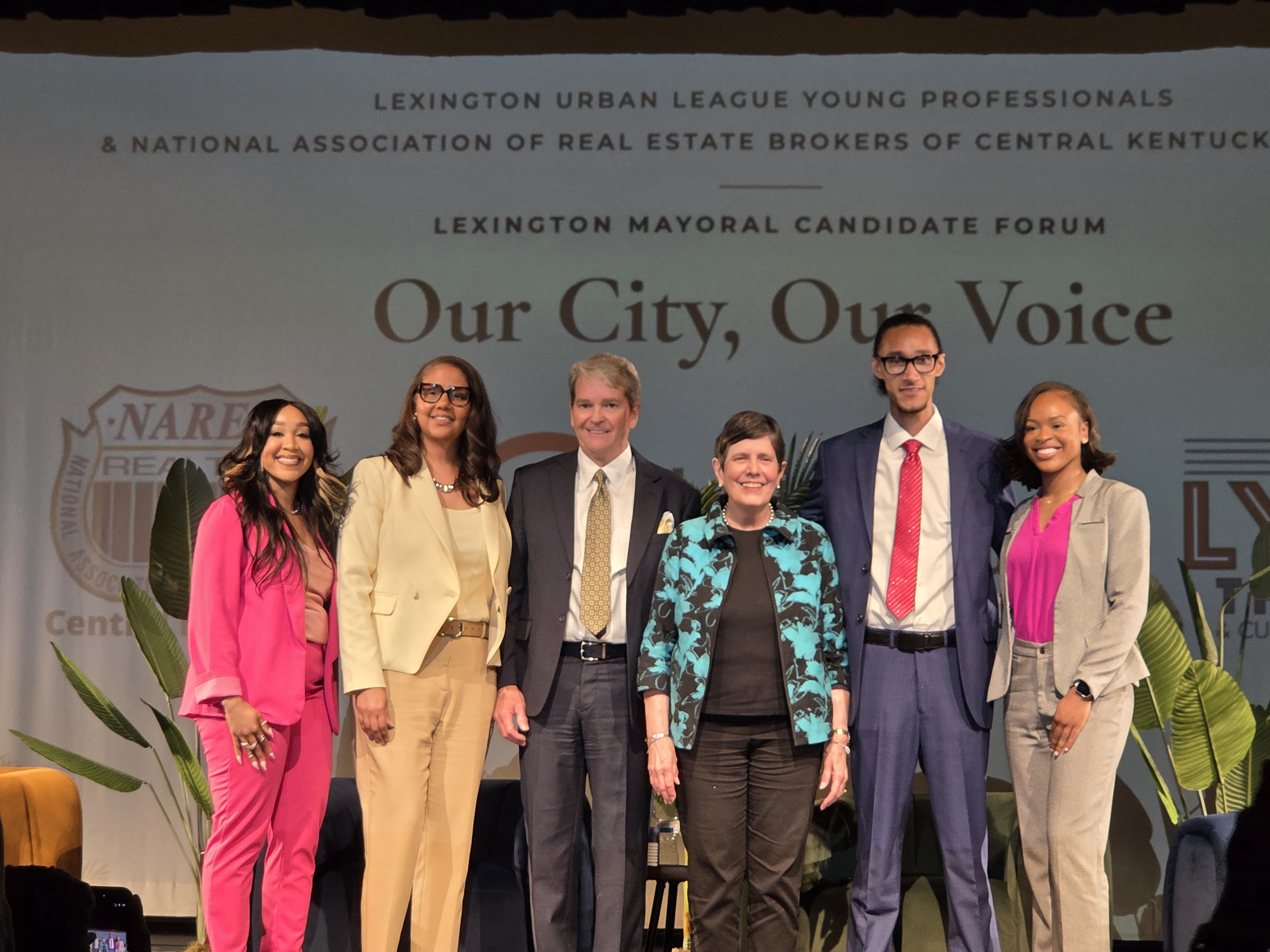
It would be a shame if Gorton and Carter don’t advance through the non-partisan May primary, as they proved the two candidates offering the best combinations of experience, knowledge, and vision.